
INTRODUCTION
Madinah al-Munawwarah — the City of the Prophet — is the second holiest city in Islam and home to some of the most spiritually significant sites in human history. While Masjid al-Nabawi is the central focus of every pilgrims stay, Madinah holds dozens of sacred locations that carry deep historical and spiritual weight.
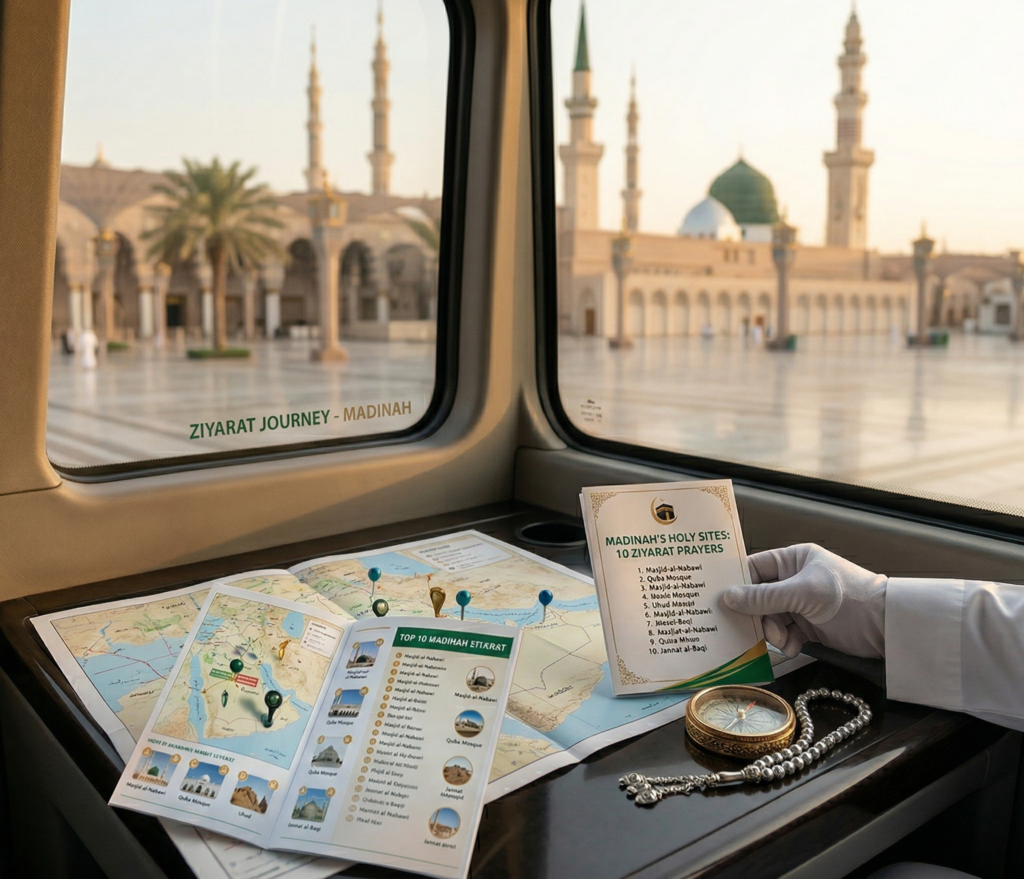
Visiting these Ziyarat sites is an enriching part of any Umrah or Hajj journey. In this guide, we share the top 10 Ziyarat sites in Madinah that every Muslim pilgrim should make an effort to visit — and how to reach them easily with a dedicated Ziyarat taxi service.
1. Masjid al-Nabawi (The Prophet’s Mosque)
The greatest mosque in Madinah and the second most sacred in Islam, Masjid al-Nabawi was originally built by the Prophet Muhammad (peace be upon him) himself upon his arrival in Madinah after the Hijra. Offering prayers here carries a reward of 1,000 times that of prayers offered elsewhere (except Masjid al-Haram). The mosque houses the blessed chamber containing the resting place of the Prophet (PBUH) and his companions Abu Bakr and Umar (RA).
2. Roza-e-Rasool (PBUH) — The Green Dome
Located within Masjid al-Nabawi, the area beneath and around the iconic Green Dome is one of the most visited spots in the world. Pilgrims stand in the Riyad ul-Jannah — the Garden of Paradise — and send salutations upon the Prophet (PBUH). It is a deeply emotional and profoundly spiritual experience for every Muslim who visits.
3. Masjid Quba
Masjid Quba holds the distinction of being the very first mosque ever built in the history of Islam, established by the Prophet (PBUH) himself upon his arrival from Makkah. Offering two units of prayer here is equivalent in reward to performing Umrah, according to an authentic hadith. It is located approximately 5 km from Masjid al-Nabawi.
4. Jannat ul-Baqi
Located adjacent to Masjid al-Nabawi, Jannat ul-Baqi is the historic cemetery of Madinah where many of the Prophet’s family members, Companions, and notable figures of early Islam are buried. The graves of Sayyida Fatimah (RA), Imam Hasan (RA), Uthman ibn Affan (RA), and thousands of Companions rest here. Pilgrims recite specific supplications and greetings when visiting.
5. Masjid al-Qiblatayn (Mosque of Two Qiblas)
One of the most historically significant mosques in Islamic history, Masjid al-Qiblatayn is where the Prophet (PBUH) received the divine command to change the direction of prayer (Qibla) from Masjid al-Aqsa in Jerusalem to Masjid al-Haram in Makkah. In the middle of prayer, the congregation turned to face the new Qibla — a moment of profound historical significance.
6. Uhud Mountain & Graves of the Martyrs (Shuhada-e-Uhud)
Mount Uhud, located about 5 km north of Madinah, was the site of the Battle of Uhud — one of the most important battles in early Islamic history. At the foot of the mountain lie the graves of the martyrs, including the grave of Hamzah ibn Abdul Muttalib (RA), the uncle of the Prophet (PBUH). The Prophet (PBUH) visited these graves and prayed for the martyrs, and Muslims follow this Sunnah when visiting.
7. Masjid al-Ghamama (Mosque of the Cloud)
Located near Masjid al-Nabawi, Masjid al-Ghamama is traditionally identified as the site where the Prophet (PBUH) offered Eid prayers. The name ‘Ghamama’ means cloud in Arabic, as legend holds that a cloud appeared overhead to shade the Prophet while he prayed.
8. Masjid al-Khandaq (Mosque of the Trench)
Built near the site of the famous Battle of the Trench (Ghazwa al-Khandaq), this mosque marks the area where the Prophet (PBUH) and his Companions dug the strategic trench on the advice of Salman al-Farsi (RA). It is part of the Sab’a Masajid (Seven Mosques) complex in the northwest of Madinah.
9. Sab’a Masajid (The Seven Mosques)
This complex of historic mosques in the Sela area of Madinah includes Masjid al-Fath, Masjid Salman al-Farsi, Masjid Abu Bakr, and others — all connected to the Battle of the Trench and the early Muslim community. It is a compact site where multiple historic mosques can be visited in a single stop.
10. Bir Uthman (Well of Uthman)
Sayyiduna Uthman ibn Affan (RA) purchased this well and donated it for the free use of all Muslims — a famous act of charity in Islamic history. It continues to flow to this day and remains a symbol of the generosity of the Companions of the Prophet (PBUH).
How to Visit All These Sites Easily
Exploring all of Madinah’s Ziyarat sites on foot or by public transport is challenging, especially for elderly pilgrims or those with limited mobility. The most practical and comfortable way to visit these sacred locations is with a dedicated Ziyarat taxi — a private vehicle with a knowledgeable driver who takes you on a guided tour of all the major sites at your own pace.
Online Taxi Hub offers half-day and full-day Madinah Ziyarat tours that cover all the major sites listed above. Our drivers are familiar with the history and significance of each location and can help make your visit truly meaningful.
CONCLUSION
Madinah is a city where history and spirituality merge at every corner. Every mosque, every mountain, every cemetery holds stories of sacrifice, devotion, and divine guidance. Make the most of your time in this blessed city by visiting as many of these sacred sites as possible.
Book your Madinah Ziyarat tour with Online Taxi Hub today.